Unlike traditional investing, which focuses exclusively on financial gains, impact investing aims to achieve both financial returns and measurable social or environmental benefits. Impact investors intentionally seek to create positive impact, setting it apart from other forms of socially responsible investing or environmental, social, and governance (ESG) investing, which may not prioritise measurable outcomes.
Table 1: The Investment Spectrum
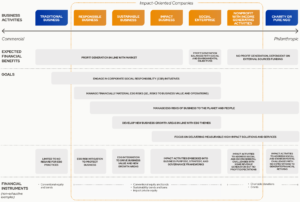
Source: Adapted by CIIP, SMU, and Accenture, based on the UNDP and Brown University
The Centre for Impact Investing and Practices (CIIP), a non-profit centre established by Temasek Trust, is dedicated to advancing the impact ecosystem in Asia and beyond. Working with regional and global stakeholders, CIIP strives to build knowledge assets and enhance capabilities, champion industry standards in impact investing and management practices, and convene stakeholders to bring about positive action in impact investing. Through this, CIIP aims to bring about more positive actions that will increase private capital allocation from companies, investors, and philanthropists towards impact outcomes—for the well-being of communities in Asia and around the world.
Many companies, particularly in Southeast Asia, have developed profitable and purposeful businesses that create measurable impact. However, these efforts and success stories often go unrecognised.
Artha Global, in collaboration with CIIP, engaged with companies across Southeast Asia to understand the complexities of balancing impact and profitability as well as integrating sustainability considerations into business operations. The purpose of writing these case studies was to spotlight these companies and highlight ways in which purpose-driven practices and profitable business models can exist harmoniously.
Developing these business-school style teaching case studies involved several key steps; first, comprehensive background research on the company was conducted. Next, key stakeholders were identified to determine the case’s narrative and highlight the critical decision-making dilemmas that marked pivotal moments for the company. The narrative typically followed a ‘protagonist’—a central stakeholder essential to the company’s success and impact generation—and was written from their perspective.
These case studies are designed as teaching tools for CIIP to educate business professionals on integrating sustainability and impact into their business processes. Below, we outline seven such case studies:
Japfa is a leading agro-food company with a focus on animal protein products. Headquartered in Singapore, the company employs over 37,000 individuals across an extensive network of advanced farming, processing, and distribution facilities located in Indonesia, Vietnam, India, Myanmar, and Bangladesh.
This case details how Japfa’s senior leadership built a compelling business case for sustainability investments, secured stakeholder support, and developed a systematic, science-based approach to integrating sustainability into its business operations. It examines the lessons learned from issuing the sustainability-linked bond (SLB) listed on the Singapore Stock Exchange in 2022, which attracted global investors, especially from Europe. It also explores Japfa’s ongoing efforts to leverage sustainability initiatives to secure capital at preferential rates through sustainability-linked loans (SLLs).
The case demonstrates how these initiatives created commercial value for Japfa, enabling the company to access innovative funding sources. It provides insight into how the culture and values of established Asian companies align more closely with contemporary impact notions than commonly perceived.
The Tolaram story began in 1948 with a textile retail shop in Malang, Indonesia. From its base in Singapore, the family business quickly expanded into wholesale and textile manufacturing. It has since grown internationally into consumer goods. Four generations of leaders have steered the business, driving innovation and partnerships and building on critical insights gained through their distinct journeys.
The case describes how Sumitra Aswani, the head of purpose and sustainability and a fourth-generation leader at Tolaram, is fostering a shared understanding of sustainability and embedding it across a diversified global family business along with her trusted team.
It highlights two key aspects of the business’s transformation:
1. Outlining essential components for integrating sustainability into the mission: This included securing leadership endorsement and building engagement within business units.
2. Detailing steps for successful implementation: This included capacity building, system setup, and data management.
In 2019, ABC Impact was established as an Asia-focused fund with two key principles: dual underwriting of impact and financial returns and creating measurable, evidence-backed impact.
This case study details how impact was underwritten for two investments—Healthcare At Home India (HCAH), an Indian out-of-hospital company, and Chongho Bridge (CHB), a Chinese integrated rural services provider. Through these investments, the case examines how ABC monitored impact created post-investment. It also emphasises the importance of intentionality in ABC’s impact strategy. In other words, it attempts to unpack how deliberately the leadership of the investee companies pursue and work towards impact as part of their core business model.
PHINMA Corporation launched PHINMA Education in 2004, using a brownfield strategy to quickly scale affordable, quality education for low-income students in the Philippines. By 2019, it expanded to Indonesia and reached 124,500 students by mid-2023.
This case discusses PHINMA Education’s response to three major disruptions—K-12 transition, free public college, and the COVID-19 pandemic—that pushed it to adopt a hybrid learning model. By continuously adapting its business model, PHINMA Ed achieved exponential growth and set a new goal: reach one million students across 4–5 countries in 5–7 years. To get there, they focused on two growth paths—expanding its market in the Philippines and entering new Southeast Asian countries—while streamlining operations to scale efficiently without losing impact or profitability.
In 2019, Olam Group founders chose a bold path for their impact mission—launching a corporate venture builder, Nupo Ventures, to incubate purpose-driven, tech-led businesses in food and agri. Rather than traditional CSR or impact investing, they aimed to create scalable, asset-light ventures that aligned with Olam’s legacy while operating independently and delivering both profit and impact.
This case looks into Nupo Ventures’ bold attempt to transform agri-business by combining digital innovation with sustainability, as well as examines the potential and pitfalls of using a venture builder model to drive impact at scale. In just four years, it launched four promising ventures—Jiva, Terrascope, RE, and Tract. But by mid-2023, a debt crisis at parent company Olam threatened Nupo’s future, cutting off capital support. With key board meetings looming, the CEO had to weigh tough strategic choices—from securing fresh funding to preparing for possible asset sales.
In 2023, Ian Wang, CEO of Chia Pang Plastics, found himself facing fresh uncertainty after seven years at the helm. Having taken over the family business in 2016 at just 28, Wang had led the Taiwanese CPVC pipe wholesaler through tough market shifts and a major buyout from his father. Inspired by B Corp values, he and his wife, Flore Ran, began reshaping the company’s approach to employees and customers. Now, with the industry evolving once again, Wang must decide how to steer Chia Pang through its next chapter.
This case explores Ian Wang’s push to reinforce Chia Pang’s position in the plastic pipe industry and sharpen its impact focus before handing leadership to a new generation. Aiming to stay ahead of market shifts, Wang sought to quickly set a fresh strategic direction while deepening the company’s impact approach—rooted in stakeholder value—that had driven its transformation since 2017.
In 2018, Johan Rozali-Wathooth established ‘Bintang Capital Partners’ as an independent private equity arm of AHAM Asset Management Berhad. Bintang strongly believes in the importance of deploying capital in an innovative, responsible, and sustainable manner, whilst pursuing consistently outsized risk-adjusted returns for its investors.
This case explores Rozali-Wathooth’s efforts to shape Bintang’s long-term impact strategy while racing to raise a larger fund to scale impact in Southeast Asia. A key milestone for Bintang was achieving the B Corporation (B Corp) accreditation, making it the first B Corp certified private equity firm in Southeast Asia. The B Corp certification is a global recognition for private businesses that meet high standards of governance, environmental, and social performance. Notably, Bintang’s goal is to create 150 new B Corp certified portfolio companies by the year 2050.
The case details the challenges Rozali-Wathooth faced in developing an impact strategy and his efforts to simultaneously raise a bigger second fund.