January 30, 2025

Rapid Insights
Survey | How Are Indians Coping with Rising Heat Stress?
This report uncovers the severe health and economic impacts of heat exposure and inadequate cooling in India, revealing the disproportionate burden borne by its poorest citizens. Using rapid surveys, it quantifies how extreme heat affects daily life, health, and productivity, highlighting the stark inequalities in coping mechanisms.
Context
India’s heatwaves are becoming longer, more frequent, and more intense, driven by the escalating effects of climate change. In 2024 alone, over 37 cities recorded temperatures exceeding 45°C, while independent reports estimate more than 700 deaths caused by extreme heat and inadequate infrastructure.
This alarming reality underscores the urgent need to address heat’s broader impacts on public health, economic productivity, and access to cooling solutions. Vulnerable populations—those with fewer resources to shield themselves—face the brunt of this crisis. This report aims to bridge the knowledge gap by exploring how heat exposure affects people across economic classes and geographies.
Read the full report here.
Methodology
To capture the scope and depth of India’s heat crisis, Artha Global’s Centre for Rapid Insights (CRI) adopted a mixed-methods approach, combining satellite, meteorological, and rapid survey data. Between May and June 2024, we conducted three focused surveys via mobile phone interviews, covering over 27,500 individuals across 20 states and Union Territories. The data was weighted using the National Family Health Survey (NFHS) to ensure it reflected mobile phone-owning households.
- Health Impact Survey (May 28-30, 2024): Measured immediate health effects like heat strokes, dehydration, and fatigue.
- Home Cooling Survey (June 6-8, 2024): Examined household cooling methods and comfort levels across demographics.
- Workplace Heat Safety Survey (June 6-8, 2024): Investigated how workers—especially those in outdoor or non-air-conditioned environments—cope with heat exposure.
Outcomes
Our findings highlight the pervasive and unequal impact of extreme heat on India’s citizens.
- Heat is causing people to fall ill
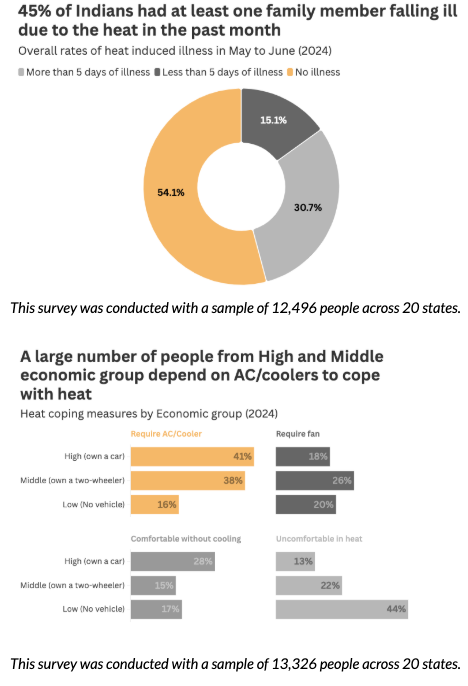
Nearly 45% of surveyed households reported at least one member falling ill due to extreme heat. Of this group, 67% indicated illnesses lasting over five days—most of them belonging to the poorest households. - Inequality in the ability to cope with heat
Economic disparities are evident in coping mechanisms. While 35% of respondents reported feeling uncomfortable even within their own homes, 42% of those living in “comfortable” environments relied on air conditioners and coolers—solutions often out of reach for poorer families. - Geographic disadvantages
As unplanned urbanisation increases, the poorest populations face a significantly higher risk of living in uncomfortable housing conditions. Our model shows that when semi-urban land coverage rises from 5% (low urbanisation) to 50% (high urbanisation), the likelihood of low-income households living in inadequate housing increases by 20%. This suggests that rapid unplanned urban expansion disproportionately impacts the poorest, pushing them into overcrowded or poorly built homes due to rising housing costs, lack of affordable options, and displacement.
Why this matters
Extreme heat is no longer just an environmental issue—it is a public health, economic, and equity crisis. This report reveals how millions, particularly those from vulnerable groups, struggle to protect themselves from heat exposure, with long-term consequences for their health, productivity, and quality of life. Addressing this requires innovative, equitable, and scalable cooling solutions that can protect lives and livelihoods as India grapples with a warming future.