January 30, 2025

Rapid Insights
Survey | Changing Dynamics: Female Labour Force Participation and Livelihood Schemes in Rural India
This report unpacks the reason and the nature of rise in Female Labour Force Participation Rate (FLFPR) in rural India. Based on surveys of 2,381 women across four northern states, the report examines the effects of husband migration, wealth, and welfare schemes on rural women’s labour dynamics.
Context
In recent years, India’s rural economy has seen a significant rise in Female Labour Force Participation Rate (FLFPR), challenging traditional assumptions about women’s roles in agriculture and informal sectors. Understanding this shift is crucial, as rural women’s participation in the workforce is shaped by a complex mix of economic, social, and policy factors.
A range of structural forces is reshaping rural India’s economy. Migration (both intra and inter state) has changed household dynamics and gender roles, affecting those who stay behind to manage agricultural and related work. The pandemic further intensified this shift, with lockdowns and urban job losses driving many workers back to villages and altering women’s roles in agriculture and household tasks.
Meanwhile, increased government spending on rural welfare—such as employment guarantee and skill development programs—has created new income opportunities, likely contributing to higher female participation in the economy.
Read the full report here.
Methodology
To examine these dynamics more closely, Artha Global’s Centre for Rapid Insights (CRI) conducted surveys across key northern Indian states—Uttar Pradesh, Madhya Pradesh, Bihar, and Jharkhand, surveying nearly 2400 married women between the ages 25 and 45 over a period of one month. We chose this group as recent data shows increasing labour force participation among young and middle-aged married women. Additionally, this social group has also been the focus of cash transfers by both central and state governments. Our idea behind adopting this targeted approach is to zoom in and add a bottom-up approach to better understand the data we collect.
Our methodology involved targeted district selection ensuring representativeness of the demographic group. Unlike other surveys, these estimates come from direct reporting from a random sample of married working age female respondents rather than from indirect reporting or household rosters.
Outcomes
- Financial need is the primary driver of Rural FLFPR
96% of women cited financial need as their primary motivation to undertake paid work. Most women engage in short-term, casual labour, with 76% in such jobs. Additionally, 57% of women in unpaid work contribute to agricultural activities, suggesting a shift towards self-employment and household labour.
- Rise in paid work for women with migrant husbands; higher paid and unpaid work among women with return migrant husbands
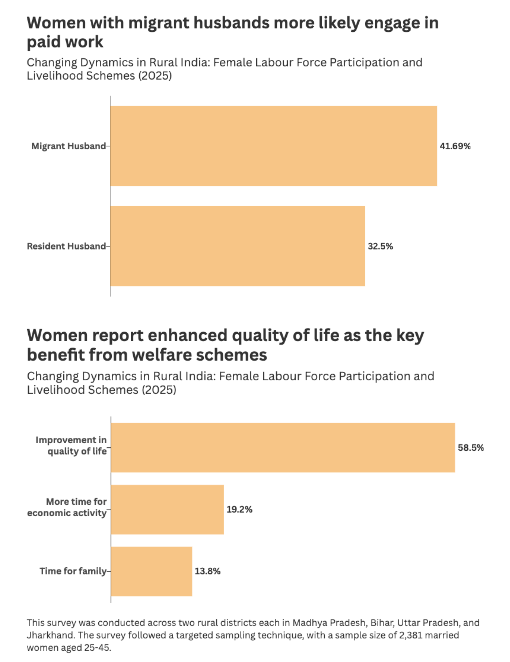
Women with migrant husbands are more likely to work for pay (42%) compared to those whose husbands are local (33%). Return migration, especially during the pandemic, increases women’s paid and unpaid work. However, the nature of migration (economic vs. strategic) impacts women’s work: economic shocks raise FLFPR, while strategic returns, such as those due to low wages, result in lower workforce engagement.v
- Welfare schemes have enhanced rural quality of life and transfers are meeting basic needs for the poor
59% of respondents cite the improved quality of life as the main benefit of schemes, while 19% report increased time for economic activity. Poor households use transfers for essential needs, including food, education, and loan repayment (75%), while wealthier households spend transfers mainly on food (52%). This highlights the different consumption patterns across income levels, with more targeted welfare interventions possibly needed for the most disadvantaged groups.
- Use of Self-Help Group (SHG) Loans
SHG loans are primarily used for household consumption, health expenses, and starting businesses. Education costs receive relatively less allocation, suggesting that DBTs may be addressing educational needs for rural households.
Why this matters
The rise in Female Labour Force Participation Rate (FLFPR) in rural India has significant implications for economic growth, gender equality, and social transformation. Understanding whether this participation translates into meaningful employment can help design better policies and welfare schemes. As male migration and changes in asset ownership influence women’s role in the workforce, report insights will help guide interventions for addressing these dynamics.