January 30, 2025

Rapid Insights
Survey | What Does Rapid Urbanisation Mean For Service Delivery in Punjab?
To evaluate whether urbanisation in Punjab is matched by improvements in service delivery, Artha Global conducted a comprehensive study on urban growth dynamics. We combined geospatial analysis with surveys of over 8,000 residents to assess access to public goods, grievance redressal systems, and commuting patterns, uncovering critical gaps in infrastructure and governance.
Context
Punjab’s urban landscape is rapidly evolving. In 2011, 36% of its population lived in urban areas. By 2036, this figure is projected to rise to 47%, representing 15.2 million people. Despite this growth, there remains a significant gap in understanding how urbanisation influences access to essential public services and transport infrastructure.
Our study sought to bridge this research gap, identifying systemic challenges that affect sustainable urban development and proposing solutions to address inequalities in service provision and mobility.
Read the full report here.
Methodology
Our approach was both data-driven and citizen-centric:
- Geospatial Analysis: We utilised satellite imagery and geospatial algorithms to classify Punjab’s 117 assembly constituencies into urban or rural categories. This analysis identified 26 urban constituencies, which were further grouped into urban clusters for focused study.
- Rapid Surveys: In these clusters, we conducted IVR-based surveys with over 8,000 residents to capture lived experiences related to public goods, grievance redressal mechanisms, and commuting habits.
Integrated Insights: Cross-referencing spatial data with survey responses enabled us to assess the adequacy of urban infrastructure and identify gaps in service delivery.
Outcomes
Our findings reveal significant disparities in the provision and accessibility of public services, highlighting systemic inefficiencies in governance and infrastructure:
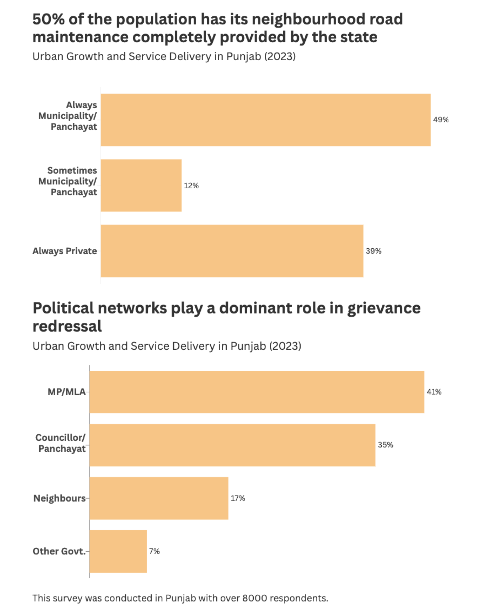
- Public Goods and Inequality: Only 50% of citizens reported access to publicly funded common goods, while 40% relied on private funding for basic services like road maintenance. This dependency on private resources exacerbates disparities, with lower-income groups disproportionately affected.
- Grievance Redressal: Political networks play a dominant role in grievance resolution, with 41% of respondents relying on intermediaries rather than formal channels like councillors or Panchayat members (35%). This reflects limited accessibility and trust in institutional mechanisms.
Transportation Challenges: Urban residents overwhelmingly depend on private transportation (90%), leading to long commutes and reduced productivity. Lower-income groups face the greatest barriers, with limited access to efficient mobility options further entrenching inequities.
By integrating spatial methods and citizen feedback, our study offers a nuanced, data-driven understanding of urban growth in Punjab. The findings underscore the urgent need for targeted policy interventions to address inequalities in service provision and transport infrastructure, ensuring that urbanisation translates into equitable and sustainable development.