December 8, 2025

Rapid Insights
Citizen Perceptions of Climate Change
The Centre for Rapid Insights conducted a rapid national survey for Deloitte and the Rainmatter Foundation as part of a larger study on climate response. The survey captured perspectives from over 1,700 respondents across 15 states, and its findings were featured in the State of Climate Response in India report.
Context
Methodology
The study captured perspectives from over 1,700 respondents across 15 states, and its findings were featured in the State of Climate Response in India report. The insights offer a rare, ground-level view of how climate change is experienced and acted upon across the country.
Understanding these behaviours matters because climate responses do not happen only through national policies. They are shaped just as strongly by how people adapt, cope, and make choices at the local level, influencing both policy outcomes and market responses.
Outcomes
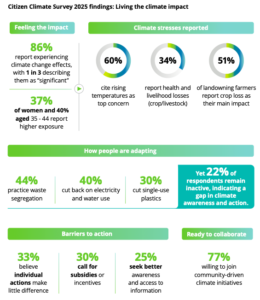
The survey reveals that climate impacts are not felt equally. Women report more severe impacts (37%) than men (30%), pointing to clear gendered vulnerabilities.
At the same time, many citizens are already taking action. Nearly half of respondents report adapting through measures such as waste segregation (44%), reducing electricity and water consumption (40%), and cutting back on single-use plastics (30%). However, 22% remain inactive, reflecting gaps between awareness and action.
Barriers to climate-friendly behaviour remain significant. A third of respondents doubt that individual actions can make a difference (33%), while others cite the need for subsidies or financial support (30%) and limited awareness (25%) as constraints.
Together, these findings point to an urgent need for a more coordinated and systematic climate response in India, one that anticipates risks, reduces inequalities, and delivers shared benefits for communities across the country.
Read the report here.