Introduction
India has risen to become the world’s fifth largest economy in terms of GDP. However, India’s economic success stands in stark contrast to its position on the Global Gender Gap Index (GGGI). According to the index, India has only closed 64.1% of the gender gap, ranking it a disconcerting 129th out of 146 nations. This ranking positions India within the bottom 20 nations on the index.
This divergence is important as 48% of India’s population comprises women. Despite making up for half of the population, women represent only 37% of India’s workforce (The Female Workforce in India: Emerging Trends and Insights, 2024) and their contribution to the GDP is a mere 18% (Singh, 2024). These statistics underscore the persistent gender disparity highlighted by the GGGI.
What is the Global Gender Gap Report ?
The Global Gender Gap Index annually benchmarks the current state and evolution of gender parity across four key dimensions: Economic Participation and Opportunity, Educational Attainment, Health and Survival, and Political Empowerment. The report should not be seen as a comprehensive treaty on gender equality, but as a highlighter of key summary statistics that can be reliably measured and tracked (Deshpande, 2023).
This year, the 18th edition of the index benchmarks gender parity across 146 economies, providing a basis for the analysis of gender parity developments across two-thirds of the world’s economies (Global Gender Gap Report 2024, 2024).
How is the index calculated?
In order to appreciate how the index is calculated, it is critical to first understand its composition. Across the aforementioned four key dimensions, there are a total of 14 indicators.
- Economic Participation and Opportunity: labour-force participation rate, wage equality for similar work, estimated earned income, legislators, senior officials and managers, and professional and technical workers.
- Educational Attainment: literacy rate, enrolment in primary, secondary and tertiary education.
- Health and Survival: sex ratio at birth and healthy life expectancy
- Political Empowerment – women in parliament, women in ministerial positions and years with female head of state (last 50)
The data for these indicators are collected from sources such as the International Labour Organization, World bank, World Health Organization and Inter-Parliamentary Union, to name a few.
The World Economic Forum has divided the process of calculating the index into four steps:
- Step 1: The index aims to capture disparities in achievements across the four parameters rather than the absolute levels. Thus, the first step is to convert all the data into percentages. For example, a country with 20% of women in ministerial positions is assigned a ratio of 20 women to 80 men, thus a value of 0.25
- Step 2: The ratios are then truncated at the “equality benchmark”. This benchmark is set at ‘1’ for all indicators except for the health indicators. For Sex Ratio at birth, the benchmark is 0.94 and for Healthy life expectancy is 1.06 indicating that women tend to live longer than men. Therefore, gender parity in life expectancy is achieved when women, on average, outlive men by five years.
- Step 3: A weighted average is calculated for the scores of each sub-index. Averaging the different indicators would implicitly give more weight to the measure that exhibits the largest variability or standard deviation. Therefore, the indicators are first normalised by equalising their standard deviations.
- Step 4: The final index is derived by taking a simple average of the scores across the 4 sub-index scores. A parity score of 1 indicates complete gender equality, while a score of 0 indicates complete gender disparity. Therefore, the gender gap represents the distance from full parity.
The latest report paints a sobering picture. Despite closing 68.5% of the gap across 146 countries, progress has been slow. Since 2006, the gap has narrowed only 0.24 percentage points every year. This sluggish pace casts doubt on the UN’s Sustainable Development Goal of achieving gender parity by 2030. At this rate, parity seems distant, with estimates suggesting that it could take 134-year wait – roughly five generations to meet the target (Global Gender Gap Report 2024, 2024).
Where do we stand now?
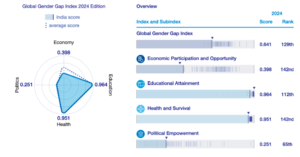
India’s own position dropped by 2 ranks in the latest edition, scoring 0.17 points lower than in 2023. This decline is attributed to small decreases in Educational Attainment and Political Empowerment, despite slight improvements in Economic Participation and Opportunity.
Figure 1: A Graphical and Tabular representation of India’s score across the four dimensions.
Source: Global Gender Gap Report 2024, 2024
On the Economic Participation and Opportunity sub index, India has closed the gap by 39.8%. Although it has seen an upward trend in terms of its economic parity in the last 4 years, it would have to bridge gender gaps in estimated earned income, legislative, senior officials and management roles, labour-force participation rate and professional and technical workers to reach its 2012 score of 46%.
In the Political Empowerment sub index, despite closing only 25.1% of its gap, India ranks 65th out of 146 countries. This goes to show that worldwide the progress towards political empowerment is staggered. India scores within the top-10 on the head-of-state indicator (40.7%) however, scores for women’s representation at the federal level, in ministerial positions (6.9%) and in parliament (17.2%), remain relatively low (Global Gender Gap Report 2024, 2024).
While progress towards gender parity is underway, many obstacles remain. Updated Educational Attainment data shows that India’s parity levels are marginally lower than previous results. The percentage of women enrolled in primary, secondary, and tertiary education is high, but it has only been rising gradually. A 17.2 percentage point gap between men and women’s literacy rates leaves India ranked 124th on the indicator.
Citations
- The female workforce in India: emerging trends and insights. (2024, March 7). Observer Research Foundation. https://www.orfonline.org/expert-speak/the-female-workforce-in-india-emerging-trends-and-insights
- Singh, A. (2024, March 1). Women contribute only 18% to GDP despite 48% share in population: Study. The Economic Times. https://economictimes.indiatimes.com/news/economy/indicators/women-contribute-only-18-to-gdp-despite-48-share-in-population-study/articleshow/108147494.cms?from=mdr#
- Deshpande, A. (2023, August 11). Gender Gap Report 21: India’s ranking continues to slide. CEDA. https://ceda.ashoka.edu.in/gender-gap-report-21-indias-ranking-continues-to-slide/
- Global Gender Gap Report 2024. (2024, June 23). World Economic Forum. https://www.weforum.org/publications/global-gender-gap-report-2024/
- Wodon, Q., & De La Briere, B. (2018). THE COST OF GENDER INEQUALITY: UNREALIZED POTENTIAL: THE HIGH COST OF GENDER INEQUALITY IN EARNINGS. https://repositorio.ciem.ucr.ac.cr/bitstream/123456789/287/1/RCIEM253.pdf
Samiksha Patnaik is an intern at Artha Global.
Banner image source: DALL – E.