Imagine an ambulance transporting a patient in critical condition has a green corridor setup without any manual intervention. The information and technology to enable this is already in-place, spread across various public authorities, private enterprises and communities. However, a comprehensive system to coordinate amongst them is lacking, and this gap can be filled by Data Exchange Systems (DES).
Emergency vehicles have GPS systems to track their location in real time, navigation services estimate traffic density and arrive at an optimised route to the destination while most cities use Adaptive Traffic Control Systems (ATCS) that automatically adjust signal timings as per traffic conditions. A DES would use the vehicle location and route information and accordingly communicate with traffic signals control systems at appropriate times to establish the green corridor.
DES are platforms that allow different organisations (businesses, governments, and even individuals) to share data in a secure and federated manner improving accessibility while allowing them to retain ownership and control. They facilitate interoperability among datasets, break data silos and enable cross-sectoral communication, redundancies, eliminate data duplication and increase efficiency.
A powerful example is DES’s use of the ‘once-only principle’, which when applied to the design of digital systems eliminates the need for people to sign up and provide their personal information on multiple portals to avail public services. Each platform/system that the user interacts with instead fetches the required information distributed across systems. Countries that have adopted this model for digital public service delivery, including Estonia, estimate that it saves them 1345 years of working time annually. DES are becoming increasingly prevalent domestically and worldwide as a model to address contemporary data challenges.
Approaches and uses of data exchange systems in India
1. eTaal (Electronic Transaction Aggregation & Analysis Layer)
Developed by India’s National Informatics Center (NIC) in collaboration with the Ministry of Electronics and Information Technology (MeitY), eTaal is a performance analysis portal that measures the adoption of e-services by monitoring and analysing electronic transactions across Government to Citizen (G2C), Business to Citizen (B2C) and Government to Business (G2B) eServices.
eTaal aggregates data from multiple government bodies to provide a standardized metric for impact assessment. It also publishes personalised reports for each Ministry, highlighting areas where digital services are underutilised or inefficient indicated by metrics like low transaction volumes and thereby to be prioritized for review and overhaul.
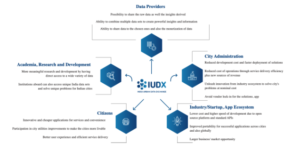
2. IUDX (India Urban Data Exchange)
IUDX, an initiative by the Ministry of Housing and Urban Affairs, is a digital infrastructure layer to enable interoperable and secure exchange of data relating to tourism, waste management and urban mobility generated by cities. IUDX integrates data from Municipalities, IoT sensors, private organisations and academic institutions. This data can be utilised to inform solutions to complex urban problems which require an interdisciplinary approach. For instance, integrated companion apps can provide information on the safest walking route at night considering which street lamps are working, crowd concentration and crime frequency.
3. Telangana : Telangana MeeSeva (ESD)
Telangana MeeSeva is a unified service provision platform that provides 600+ services across 50 government departments. It integrates information from multiple sources alongside facilitating digital payments (T-Wallet) and real-time digital identity verification (RTDAI). The Hyderabad Metropolitan Water Supply and Sewerage Board (HMWSSB) leverages it to allow consumers to view and pay their water charges by accessing real-time billing information pulled directly from the board’s databases, while the Panchayat Raj Trade License Fee Payment facilitates digital renewal of trade licenses through an integrated system that shares verification and payment data across departments.
4. AgriStack
AgriStack is a digital platform and data exchange system developed by the Ministry of Agriculture and Farmer Welfare that enables development of higher order services or schemes that can serve farmers. AgriStack facilitates various states to collate data on farmers, their landholdings and crops sown to verify their eligibility for government schemes. It also provides a unified interface and APIs for interoperable and managed exchange of data with private sector entities like banks, startups that can leverage it to design and offer services like credit, insurance, personalised advisory, market access etc.
Examples of DES around the world
1. Uganda: UGhub
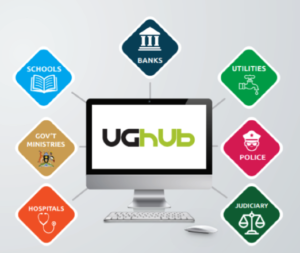
UGhub, developed by Uganda’s National Information Technology Authority (NITA-U), is a data exchange platform that facilitates data exchange between Government Ministries to provide services such as tax filing and identity verification. For example, the Ministry of Land uses data from the National Identification and Registration Authority (NIRA) to confirm identities during land title issuance. Further, the Ministry of Gender and Social Development utilises NIRA and Ministry of Finance data for targeted welfare distribution.
2. Israel: Health Information Exchange (HIE)
The Israeli Ministry of Health developed the HIE for secure and seamless exchange of healthcare data. Prior to HIE, citizens’ medical history was fragmented between private practitioners, state-run hospitals and specialist clinics. HIE enabled interoperable data exchange between each of these entities. Rather than collating data in a centralised repository, HIE takes a decentralised approach allowing data to remain in its original location while still being accessible. The implementation of HIE has significantly reduced unnecessary testing, allowed for more accurate diagnoses and can provide crucial information in emergency situations. HIE was vital in mitigating the impacts of the COVID-19 pandemic, providing real-time information on vaccination status of individuals.
3. Estonia: X-Road
Estonia’s X-Road platform developed by the Information System Authority in 2001 is an open-source secure data exchange that connects decentralized databases through end-to-end encrypted channels. This platform powers ~3000 e-services, some examples include healthcare where patient genetic data and their medical history are used for precision medicine, a digital ID called “e-ID ”that citizens can use to validate banking transactions, digital signatures and even online voting. It processes 2.2 billion transactions annually and is also used by 52,000 organizations.
The way forward
Success of national and global DES is underscored by a commitment to improving the quality of life for citizens and securing public trust. DES must implement robust security frameworks, ensure ethical usage of data and develop interfaces designed to be intuitive for people of varying levels of digital literacy. The most viable DES model exemplifies inclusivity, interoperability and transparency.
In accordance with these ideals, various regulatory frameworks exist to guide their implementation – the European Interoperability Framework (EIF) provides principles of public sector data sharing; India’s Data Empowerment Architecture (DEPA) ensures consent-based data sharing in finance and health sectors; and the UN Global Platform for Official Statistics is an architecture for secure data collaboration between countries. DES, if constructed thoughtfully, can serve as a transformative infrastructure to improve efficiency and create markets for new products and services.
Aditi Choudhary is a former intern at Artha Global
Bibliography
Dolan, J. (2024, August 6). Integrated National Data Exchange Systems: Uganda
Case Study. Digital Alliance.
https://dial.global/research/integrated-national-data-exchange-uganda-case-
Gowani, I. (2023, September 20). Seamless data exchange: best practices for
modern businesses.
DATAVERSITY.
https://www.dataversity.net/seamless-data-exchange-best-practices-for-mo
Healthcare Israel. (n.d.). The Implementation of a National Healthcare Exchange Platform. IDB.
https://publications.iadb.org/en/implementation-national-health-information-exchange-platform-israel
The Ministry of Electronics and Information Technology. (n.d.). Electronic Transaction Aggregation Analysis Layer.
https://etaal.gov.in/
The Ministry of Housing and Urban Affairs. (n.d.). Indian Urban Data Exchange.
https://iudx.org.in/
The Ministry of Electronics and Information Technology. (n.d). Telanga MeeSeva. Umang.
https://web.umang.gov.in/landing/department/telangana-meeseva.html
Tom, K ., Alexandra, J. ( 2025, June 10th). What is Data Exchange?. IBM.
https://www.ibm.com/think/topics/data-exchange
https://iudx.org.in/wp-content/uploads/2021/05/01-Green-corridor-for-emergency-vehicles.pdf
https://iccc.niua.org/pdf/IUDX-Compendium-of-Use-Cases.pdf