
In collaboration with New America, we hosted a panel discussion at the AI Impact Summit 2026 that explored what sovereignty in an AI age meant for middle- and low-income countries. The panel featured Kate Kallot, Founder & CEO of Amini AI, Natalie Black, Group Director for Infrastructure & Connectivity and Executive Board Member at Ofcom, Pablo Chavez, Adjunct Senior Fellow with CNAS’s Technology and National Security Program and Shashi Shekhar Vempati, co-Founder of DeepTech for Bharat Foundation. The session was moderated by Akash Kapur, Senior Fellow at New America and Visiting Research Scholar at Princeton University.
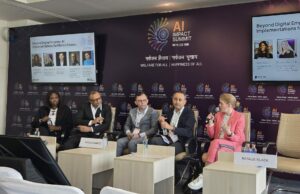
What emerged from this discussion, was that countries navigating geopolitical pressure, limited capital, and uneven digital infrastructure must balance managing risk with building domestic technological capacity. For many low- and middle-income countries, AI sovereignty is less about complete control over the technology stack and more about retaining meaningful choice, adaptability, resilient supply chains, and solutions that are locally relevant.
While global partnerships can support capacity-building and foster homegrown AI ecosystems, they also create potential dependencies. This is where regional alliances such as the Economic Community of West African States (ECOWAS) and emerging collaborations like the South Korea–Indonesia AI initiative, illustrate alternative pathways that pool resources, promote data localisation, and strengthen collective resilience.