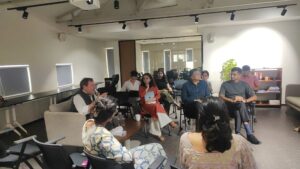
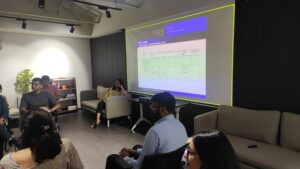
At our recent Brown Bag, Dr. Jean-Louis Arcand explored how satellite night-time light and remote sensing data can bridge data gaps in development economics. The idea is simple yet powerful — where there’s activity and development, there’s light. Using NASA’s Black Marble data, researchers can track growth, destruction, or migration through changes in night-time luminosity. In Morocco, for instance, a rural development programme under the National Initiative for Human Development (INDH) was evaluated through changes in night-time light. Areas that received support saw a 19% rise in luminosity between 2005 and 2010, offering a visible measure of progress.
From estimating GDP where surveys fail to testing long-standing development theories, remote sensing has emerged as a powerful tool to illuminate the dark spots of data scarcity. The session highlighted how new technologies are expanding the frontiers of impact evaluation and helping economists better understand patterns of growth and development across regions.
Professor Jean-Louis Arcand is a Canadian economist and Professor of Economics at the Graduate Institute of International and Development Studies in Geneva, as well as an Affiliate Professor at the Université Mohammed VI Polytechnic in Rabat. He is a Founding Fellow of the European Development Research Network (EUDN), a Senior Fellow at the Fondation pour les études et recherches en développement international (FERDI), and has been a Visiting Professor at Renmin University of China in Beijing, Universidade Federal da Bahia, and several universities in Africa and the Caribbean. He previously served as Assistant and then Associate Professor at the University of Montréal, and Professor at the Centre d’études et de recherches en développement international (CERDI).