Over the past decade, the idea and reality of digital public infrastructure (DPI) have gained widespread legitimacy. This is particularly so in developing economies across the global south. Population-scale proof of success may seem relatively thin on the ground yet, but the pace of progress in several jurisdictions–India and Tanzania, for instance–is arguably unmatched in the history of paradigm-shifting governance innovation.
This progress–and political buy-in for government implementation of DPI–rests on two planks. The first is its ability to have nation-scale impact, break down silos, improve efficiency and allow for a whole-of-government approach to service delivery. In short, it makes government work better with more efficient allocation of resources in the long run. The second is the evolution of the citizen-state relationship from the existing patron-client model to one of fellow stakeholders. This is key to making inclusive systems in the manner that the Sustainable Development Goals call for.
The latter plank is crucial. Availability and usage alone do not make for ‘good’ DPI; their long-term on-ground impact is equally important. This requires feedback loops and tight integration of end-user and co-creator stakeholder communities. Such integration is also essential for two of the three nodes of the strategic triangle framework (see Figure 1) used to assess institutional arrangements and governance models for digital public goods (DPG) (and equally applicable for DPI): public value, and legitimacy and support. While the core functions and value that DPI deliver require governments to have strategic control over these critical assets, exploring institutional arrangements that address valid concerns of sovereignty and independence, while widening the spheres or stakeholders with influence, is crucial.
Figure 1: The Dilemma in DPG Governance
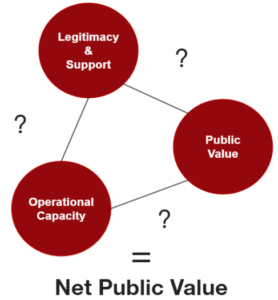
Source: Best Practices for the Governance of Digital Public Goods
Key issue
The gold standard of digital multistakeholder management is the open source model. By this, we do not mean merely making the code publicly available; this is a minimal version of open source. To quote Pramod Varma (Chief Architect of Aadhaar, India’s digital identity programme), technology is just one component of DPI. Any deployment of digital public infrastructure must also consider participation rules, grievance/dispute management, trust architecture, incentive alignment of all participants, societal readiness to adopt, demand drivers, sustainability, privacy and security. Meaningful roles and participation of beneficiaries, intermediaries, and public authorities in institutional governance models–as has been done successfully when it comes to a number of DPGs–is key to incorporating these elements in a manner that fulfils the potential of citizen empowerment. However, the focus of most governments that have deployed DPI thus far has been on its ability to enable more efficient governance processes; incorporating other stakeholders has often not been a priority. Thus, some of the most well-known DPI, such as Aadhaar and Unified Payments Interface, exhibit different degrees of openness for code, standards and participation.
What institutional arrangements can unlock the full potential of DPI?
An approach that emphasises openness will require reconfiguring the institutions that create and sustain DPI. While high-level frameworks that assess the public sector’s institutional readiness for open source exist, these are inward looking and limited to only technical outcomes, which lack attention to the continuum of stakeholder influence, central to our vision for good DPI. To create a model that works, several questions must be explored:
- What institutional arrangements can help embed principles of equity and fairness in the design of DPI?
- What can we learn from established success stories such as Health Information Services Programme and newer entrants like Nordic Institute for Interoperability Solutions and Mojaloop Foundation about their institutional evolution to support communities of practice, uphold principles of openness in design, and navigate conflicting requirements and direction for their DPG roadmap?
- How can the maturity of the DPI inform its openness and obligations to contribute back to the DPG ecosystem?
- What can we learn from the open source ecosystem about sustainable community building, inclusiveness and providing public value, while also avoiding the issues plaguing open source software development?
- What institutional arrangements can best mediate the tension between the government drive to retain absolute control of DPI situated within them and open source principles and models?
The exploration exercise will create forward-looking theoretical frameworks, playbooks and case studies from experiences of governments around the world. These will support the necessary action to evolve fit-for-purpose institutions suited for a digital future.