The current state of India’s Artificial Intelligence (AI) policy is one of caution and adaptability. The recent AI advisory released by the Ministry of Electronics and Information Technology (MeitY) highlights India’s evolving approach to the industry. This blog aims to offer a comparative study of the objectives, principles, and approaches to the governance of AI in India with that of other leading global actors such as the European Union (EU), United States of America (USA), China. Specifically, it will delve into the varied approaches each regime takes to AI regulation to shed light on India’s stance and points to the need for a more cohesive and unified approach to AI governance.
AI Regulation in India
The accelerated growth of AI, accompanied by its regulatory uncertainty has raised well-placed concerns about its potential and perils. As AI permeates deeper into society, questions of governance become increasingly paramount. In the latest attempt to regulate AI, MeitY released an AI advisory on 1st March 2024 which was subject to back and forth before it was replaced with a revised advisory on 15th March 2024.
Image 1: MeitY AI Advisory Timeline
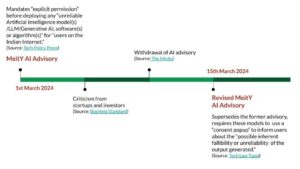
The initial advisory sought to contain the premature deployment of AI models, algorithmic bias and the spread of deepfakes by mandating a ‘permission prior to deployment’ process for under-tested and unreliable AI platforms (Agrawal, 2024). The advisory necessitated platforms and intermediaries to obtain explicit permission from the government before deploying their AI models. However, after being met with criticism from local startups, investors, and experts on the grounds for its ambiguity and impact on innovation, the advisory has been rolled back and replaced (Mishra, 2024). The newly published advisory does not require intermediaries and platforms to obtain explicit permission from the government to deploy foundational models but stresses on the need to explicitly inform users about the unreliability of the output. Nonetheless, there are concerns about the new advisory’s legal backing and regulatory ambiguity, as experts say there is a lack of clarity on whom it applies to and how it should be complied with (Mohanty, 2024).
Notwithstanding the limitations of the limitations of the AI advisory, it marks India’s headway in developing a draft AI regulation framework (Mohanty, 2024). As India aims to position itself at the forefront of the conversation on AI governance, the following section compares India’s approach with that of the European Union (EU), United States of America (USA) and China as these countries have made considerable progress in developing AI frameworks and articulating an approach to its governance.
Comparative Analysis of the Regulatory Approaches to AI Governance
A comparative analysis of the objectives, principles and approaches across the EU, USA, China and India. The objectives identify the goal of the government vis-a-vis its AI governance, the principles lay down the guidelines which it aims to comply with, and the approach details the manner in which initiatives are adopted.
Table 1

Analysis of region-specific approaches to AI
The EU has adopted a risk-based approach that emphasises the importance of ethics, accountability and transparency in the AI systems. Through regulations such as the General Data Protection Regulation (GDPR)¹ and the AI Act, the EU seeks to establish clear rules to mitigate risks associated with AI deployment through a first-of-its-kind legal framework.
On the other hand, the US favours a pro-market approach which prioritises innovation and economic competitiveness. They have made regulatory efforts at the federal level through the Blueprint for an AI Bill of Rights² and the voluntary AI Risk Management Framework.³ However, the US lacks a federal framework to regulate AI; it largely relies on industry for this.
Finally, China promotes a state-led pro-innovation stance wherein the government actively promotes AI development through strategic investments and initiatives like the New Generation Artificial Intelligence Development Plan. However, the ad-hoc intervention of the state raises concerns regarding state surveillance and the lack of transparency (Roberts et al., 2022).
While these approaches may differ due to their varying priorities, capabilities and challenges, what is consistent is that they have an approach.
In the case of India, the focus is on leveraging AI for economic growth and social development. However, there has been no concrete update in India’s official ‘objective’ for AI governance vis-a-vis its dynamic developments as India’s approach still seems to be evolving (Shaoshan Liu, 2023). Furthermore, the recent back and forth with the AI advisory and its impact on innovation suggest that there is a need for a cohesive and centralised approach.
Conclusion
While India may not currently have a well-defined approach to AI governance, the recent developments and revisions in its AI advisory demonstrate a clear intent towards establishing a more structured framework. India has adopted a cautious yet adaptive stance on AI regulation, balancing the need for innovation with the imperative of responsible deployment. It would be interesting to watch how India’s approach to AI governance evolves in comparison to the more established frameworks of the EU, USA, and China. The journey towards a comprehensive AI governance model in India is well underway, and the unfolding developments promise to contribute meaningfully to the global discourse on AI regulation.
Endnotes:
- The General Data Protection Regulation sets guidelines for the collection and processing of personal data of individuals within the European Union. https://gdpr.eu/what-is-gdpr/
- The AI Bill of Rights sets ethical guidelines, protecting individuals from algorithmic discrimination and promoting the responsible use of AI. https://www.whitehouse.gov/wp-content/uploads/2022/10/Blueprint-for-an-AI-Bill-of-Rights.pdf
- The AI RIsk Management Framework is intended for voluntary use and to improve the ability to incorporate trustworthiness considerations in AI products and systems. https://nvlpubs.nist.gov/nistpubs/ai/NIST.AI.100-1.pdf
- The New Generation Artificial Intelligence Development Plan articulates China’s public plan to expand AI in many spheres of manufacturing, governance and national defence. http://fi.china-embassy.gov.cn/eng/kxjs/201710/P020210628714286134479.pdf
References:
Agrawal, A. (2024, March 8). Advisory on AI models sent after inconsistent outputs: IT secretary. Hindustan Times. https://www.hindustantimes.com/india-news/advisory-on-ai-models-sent-after-inconsistent-outputs-it-secretary-101709839000579.html
Liu, S. (2023, October 27). India’s AI Regulation Dilemma – The Diplomat. The Diplomat. Retrieved May 2, 2024, from https://thediplomat.com/2023/10/indias-ai-regulation-dilemma/
Mishra, A. (2024, March). Govt’s AI advisory leaves experts discontent and calls for clarity. Business Standard. https://www.business-standard.com/industry/news/modi-led-govt-believes-in-capabilities-of-india-in-defence-sector-rajnath-124030700441_1.html/industry/news/govt-s-ai-advisory-leaves-experts-discontent-and-calls-for-clarity-124030700981_1.html
Mohanty, A. (2024, April). Beyond the AI advisory. Techlawtopia. https://www.techlawtopia.com/beyond-the-ai-advisory/
Roberts, H., Cowls, J., Hine, E., Morley, J., Wang, V., Taddeo, M., & Floridi, L. (2022). Governing artificial intelligence in China and the European Union: Comparing aims and promoting ethical outcomes. The Information Society, 39(2), 79-97. https://www.tandfonline.com/doi/full/10.1080/01972243.2022.2124565