Introduction
Every industry in the modern age struggles to optimise its workflow efficiently due to the multitude of variables impacting them. Modern companies also face a unique problem of data overload owing to the volume of data collected by firms. For example, technology firms have access to large amounts of customer data but are unable to efficiently identify actionable insights and courses of action to improve their businesses.
The International Data Corporation predicts that 175 zettabytes (175 trillion gigabytes) of data will be produced in 2025 (Reinsel, 2020). Classical computers or traditional computers cannot effectively compute and find patterns in such enormous data sets. Quantum computers, on the other hand, can store and process large sets of data, and provide insights that classical computers would have found impossible.
Technology firms also have a number of internal factors they must consider to optimise their efficiency, such as their distribution of labour, and project management, among others. These factors are currently considered manually by a combination of trial and error and individual skill (Bova, 2021). They cannot be efficiently solved by classical computing due to the number of inputs that increase with scale and shift per calculation. However, quantum computing can efficiently address optimisation problems due to its ability to compute multiple variables simultaneously.
What are Classical and Quantum Computing?
Classical computing, ubiquitous in our digital world, is a method of processing data stored in bits (Bova, 2021). Bits, or binary digits, are the smallest units of data that a computer can process and store. As the number of bits increases in a code, or a set of computing instructions, the processing time and power required by the computer increases. However, there are problems that even large supercomputers cannot compute due to a lack of processing power. These are typically highly complex problems where many variables interact and overlap. For example, a classical computer would find it impossible to simulate how engineered molecules interact with each other in a lab, as this would involve individually calculating every permutation of the reaction. These types of calculations, generally referred to as combinatorics, are what quantum computers excel at.
Figure 1: Quantum Computer
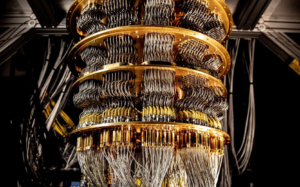
Source: Google Quantum Computer – The Telegraph
Bits are deterministic and can only have two values: 1 (on) or 0 (off). In contrast, qubits, or quantum bits, can simultaneously represent a combination of numbers between 0 and 1 due to their indeterministic nature. Deterministic computing, as the name suggests, does not allow for variance and always produces specific and reproducible results, i.e. binary results as 1 or 0. Indeterministic computing, on the other hand, leverages the inherent variance at the sub-atomic level of the world. Consequently, it can only provide a range of answers with varying levels of probability.
Figure 2: Visualisation of bits and qubits
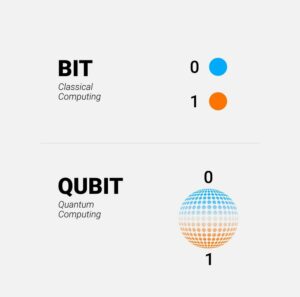
Source: Understanding Quantum Bits (Qubits)
This variance has far-reaching consequences, and the limitation of bits becomes visible when classical computers have to process multiple variables. They must recalculate every time a variable is changed and store the result. On the other hand, quantum computers can explore many permutations simultaneously due to the nature of qubits and produce a range of answers quickly.
In the image below, a classical computer would have to calculate each strand individually, restarting from the first variable each time. In contrast, a quantum computer would simultaneously process all these possible permutations and provide the last row of outputs as a range of answers. As a result, when more qubits are added to a quantum computer, its calculation power increases exponentially. In contrast, in classical computers, calculation power is linearly connected to the number of transistors (switches that physically represent the 1s and 0s of bits).
Figure 3: Permutation Visualisation
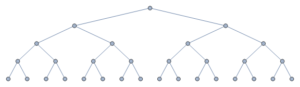
Source: Permutation Tree Plot
While quantum computing will solve many of the problems that classical computing faces, it will not replace it due to its inherent indeterministic nature. Quantum computers can only be used to calculate a range of answers sorted by probability levels. As such, classical computing must be employed to hone in on one specific answer. Classical computing and quantum computing must work in tandem to achieve deliverable breakthroughs.
Raja Chettiar is an intern at Artha Global.
References
– Bova, Francesco, Avi Goldfarb, and Roger G. Melko. “Commercial Applications of Quantum Computing.” EPJ Quantum Technology, vol. 8, no. 1, Dec. 2021, p. 2. DOI.org (Crossref), https://doi.org/10.1140/epjqt/s40507-021-00091-1.
– Bova, Francesco, Avi Goldfarb, and Roger Melko. “Quantum Computing Is Coming. What Can It Do?” Harvard Business Review, 16 July 2021. hbr.org, https://hbr.org/2021/07/quantum-computing-is-coming-what-can-it-do.
– kglr. “Answer to ‘Construct a Permutation Tree Plot.’” Mathematica Stack Exchange, 26 Jan. 2021, https://mathematica.stackexchange.com/a/238821.
– Gamble, Sara. “Quantum Computing: What It Is, Why We Want It, and How We’re Trying to Get It.” Frontiers of Engineering: Reports on Leading-Edge Engineering from the 2018 Symposium, National Academies Press (US), 2019. www.ncbi.nlm.nih.gov, https://www.ncbi.nlm.nih.gov/books/NBK538701/.
– What Is Quantum Computing? | IBM. 28 Feb. 2024, https://www.ibm.com/topics/quantum-computing.
– Newton, William. “Quantum Medicine: How Quantum Computers Could Change Drug Development.” Clinical Trials Arena, 24 Feb. 2023, https://www.clinicaltrialsarena.com/features/quantum-computers-drug-development/.
– Ostojic, Ivan, et al. “A Game Plan for Quantum Computing .” Mckinsey Digital, https://www.mckinsey.com/capabilities/mckinsey-digital/our-insights/a-game-plan-for-quantum-computing. Accessed 10 May 2024.
– Reinsel, David, et al. The Digitization of the World: From Edge to Core. White Paper, IDC, May 2020, https://www.seagate.com/files/www-content/our-story/trends/files/dataage-idc-report-final.pdf.
– Vaibhav. “Understanding Quantum Bits (Qubits).” Medium, 8 Nov. 2023, https://medium.com/@vaibhavpol49/understanding-quantum-bits-qubits-ca7c154023df.
– Vermaas, Pieter, and Ulrich Mans . Quantum Technologies and Their Global Impact. UNESCO, 2024, p. 15, https://unesdoc.unesco.org/ark:/48223/pf0000388955.