‘The air that keeps us alive is making us sick’, UN experts warned on a Clean Air Day (2022), reiterating how air pollution is a growing concern worldwide. In India, the situation is particularly alarming with 131 cities categorised as non-attainment cities covered under the National Clean Air Programme (NCAP). These cities have failed to meet the national ambient standards for either PM2.5, PM10, or NO2 for five consecutive years (2011–2015).
To combat this global crisis, governments and cities are rapidly turning towards Clean Air Zones (CAZs) as a strategic solution. According to C40 Cities, Clean Air Zones (or Low Emission Zones) are areas of a city where targeted action is taken to improve air quality, often banning or discouraging the most polluting vehicles from entering the zone through a daily fee to enter. They usually start at the area where pollution levels are high and can expand once established.
The rationale behind implementing CAZs is beyond just improving air quality; it encompasses the broader goals of public health protection, promoting cleaner mobility, and reducing road congestion. These are critical to reducing air pollutants such as Nitrogen Oxides (NOx) and particulate matter, thereby enhancing the living conditions within urban environments.
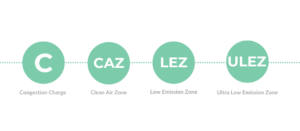
Image is created by the author
Evolution and use case of tools in different cities
To improve urban air quality, cities around the globe use a range of innovative strategies tailored to local needs and context. These often involve combinations of policy tools and technological advancements to reduce emissions.
Congestion Charging (CC) is a widely adopted strategy to reduce traffic congestion and associated emissions. London first studied the concept of congestion charging in the mid‐1960s. Inspired by these studies, Singapore implemented its first Area Licensing Scheme (ALS) in 1977 (ICCT, 2010). Later in 1998, Singapore introduced Electronic Road Pricing (EPR) based on ALS, which is a prime example of CC. EPR uses electronic gantries to automatically charge vehicles passing through congested zones with dynamically adjusted fees on real-time traffic conditions.
London illustrates a progressive approach in air quality management, evolving from congestion charging to Low Emission Zones (LEZs) and eventually to Ultra Low Emission Zones (ULEZs). This journey began with the introduction of CC in 2003, aimed at reducing traffic in the central area. By 2008 they expanded it with LEZ’s, targeting heavy diesel vehicles. In 2019, they brought even stricter emission standards with ULEZ’s, applicable to a broad range of vehicles, including motorcycles and buses. This evolution led to substantial reductions in emissions making London a leading example in air quality management.
A Zero-Emission Zone (ZEZ) is an area where only zero-emission vehicles, pedestrians, and cyclists are granted unrestricted access. Other vehicles are either prohibited or permitted entry upon payment of a fee (ICCT, 2021). Rotterdam, in the Netherlands, initially implemented ZEZs in its center and aims for its entire logistics sector to be zero-emission by 2025.
Shenzhen opted for Green Logistic Zones specifically focusing on reducing freight and delivery operations emissions. Light-duty fossil fuel trucks weighing less than 4.5 tons are prohibited in these areas. This strategy is part of a broader plan to electrify Shenzhen’s entire vehicle fleet.
In India, several cities are striving to become cleaner and greener by promoting sustainable transport alternatives. Kevadia is aspiring to be India’s first electric vehicle city starting with an electric vehicle-only zone around the world’s tallest statue, the Statue of Unity. The historical market area of Delhi, Chandni Chowk has transformed into a pedestrian-only zone, encouraging the use of bicycles and electric rickshaws. Also, several Indian cities tried different versions of CAZs: Bengaluru’s one-year pilot at church street showed benefits, (IISC Report), but was eventually discontinued. Similarly, Pondy Bazaar, JM Road, and Chandni Chowk have launched their CAZs, yet these remain individual efforts without a unified strategy.
Why is there variability across locations?
Implementing CAZs across different cities requires tailoring strategies to fit the contextual needs. Successful CAZ implementation requires engaging local stakeholders, including residents, businesses, and transport operators. Inter-agency coordination between various government agencies is crucial to enforce CAZ initiatives seamlessly.
Designing and implementing CAZs requires a data-driven approach, comprehensive data on air quality, traffic patterns, and emissions helps cities identify high-polluting areas.
Creating a positive revenue generation from CAZs is another critical aspect of improving transport infrastructure. Singapore’s EPR system generates about SGD 150 million annually while controlling vehicular emissions. While generating revenues, CAZs also need to contribute positively to the local economies offering an opportunity for local businesses to transition to the green economy.
Way forward
Indian cities are making significant developments in strategising around CAZs, although the process is fragmented. Efforts in Delhi’s Chandni Chowk, EV adoption in Kevadia, and traffic restrictions in Bangalore’s Church Street are promising examples. However, these initiatives lack a unified, city-wide strategy. The absence of direct funding and integration with the broader city and mobility planning frameworks hinders the implementation of CAZs. Cities and local-level governments have to come forward to take up this contextual challenge to combat urban air pollution and create healthier, more liveable cities.
Kishor Avhad was an intern at Artha Global.
Banner image source: DALL – E.