Introduction
You must have noticed the advertisements on your device getting increasingly more accurate to your tastes and preferences. Why does this happen? A lot of it has got to do with apps collecting data to personalise advertisements for users. Your activity across the internet is being used to categorise and provide ads that are relevant to you. This collection and mining of data is what makes targeted advertising possible.
Understanding Targeted Advertising
Targeted advertising is a specific form of marketing which involves categorisation of advertisements based on a consumer’s traits, preferences, and behaviours (Iyer et al., 2005). Many find this an invasion of their privacy, while others prefer this method of advertising as it caters to their needs and wants (Lau, 2023).
Interestingly, search engines and social media companies like Google and Meta primarily earn their revenues by selling spaces for advertisements. Both companies are expected to dominate the global advertising space, with growth rate estimates increasing from 7% to 11% from 2023 to 2024 (Otto, 2023).
Figure 1: Big 3 Ad Revenue
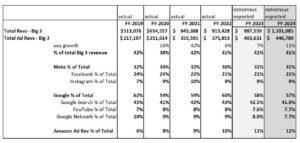
Source: Visible Alpha, 2023
Forms of Targeted Advertising
Targeted advertisements come in various forms, some of which are mentioned below:
- Contextual Targeting
Contextual advertising consists of placing advertisements that are relevant to the on-page content (What Is Contextual Targeting? | Mailchimp, 2023). This helps tell consumers that the advertisement is related to something they are interested in (Lau, 2023).
- Behavioural Targeting
This form of advertising is similar to contextual advertising except for the fact that it collects the user’s digital footprint to suggest relevant ads to consumers, this can include tracking the user’s browsing history, links clicked, products purchased, time spent on web pages, and so on (Lau, 2023).
- Geotargeting
Geotargeting is useful for advertisers with local and regional audiences as it publishes ads based on a consumer’s location. This is helpful for companies trying to sell a location specific product or to advertise an event in a specific place (Lau, 2023).
- Social Media Targeting
A form of advertising that has picked up in the past few years, social media targeting involves presenting ads on the platforms itself. Marketers can advertise their products through social media platforms used by consumers. Since social media companies collect heavy amounts of user activity data, they are able to provide ads that are highly targeted, down to specific groups of users (Deshpande, 2022).
Meta is known to be one of the most invasive companies on the web. Apps like Instagram, Threads, Facebook, and Messenger collect about 86% of user data, part of which is collected to display third party advertisements (Khatwani, 2023).
Discussion
While consumers appreciate receiving tailored ads that suggest products and services that match their needs, it can be unsettling to know that their activities can be tracked across the internet. Providing users with the option to control what activities are tracked can help alleviate concerns. Many social media applications, including Instagram, now offer optional tracking across apps. Recently, Meta introduced the “Activity Off-Meta Technologies” feature, an expansion of the previously named “Facebook Off Activity”. This feature allows users to prevent the app from tracking their digital footprint across the internet, giving them greater control over what data other apps can share with Meta and vice versa (Bhati, 2023).
Targeted advertising is an effective marketing strategy that delivers personalised ads, increasing the likelihood of user engagement and boosting the revenue of the advertising company (What Is Personalization?, 2023). For users, having the ability to select what data is used by websites and apps not only enhances their online experience but also reduces the discomfort of feeling constantly monitored.
References:
Iyer, G., Soberman, D., & Villas-Boas, J. M. (2005). The targeting of advertising. Marketing Science, 24(3), 461–476. https://doi.org/10.1287/mksc.1050.0117
Lau, W. (2023, May 15). What is Targeted Advertising? AdRoll. https://www.adroll.com/blog/what-is-targeted-advertising
What is personalization? (2023, May 30). McKinsey & Company. https://www.mckinsey.com/featured-insights/mckinsey-explainers/what-is-personalization
Otto, M. (2023, July 26). Global Digital Advertising Revenues – A look at the big three: Alphabet (GOOGL), Meta Platforms (META), Amazon.com (AMZN). Visible Alpha. https://visiblealpha.com/blog/global-digital-advertising-revenues-a-look-at-the-big-three-alphabet-googl-meta-platforms-meta-amazon-com-amzn/
What is contextual targeting? | Mailchimp. (2023, February 10). Mailchimp. https://mailchimp.com/resources/what-is-contextual-targeting/
Deshpande, I. (2022, November 24). What is social media advertising? Definition, costs, best practices, benefits, and examples. Spiceworks Inc. https://www.spiceworks.com/marketing/advertising/articles/what-is-social-media-advertising/#:~:text=Social%20media%20advertising%20is%20an,channels%20that%20users%20frequently%20use.
Khatwani, S. (2023, November 21). Study Reveals: Threads is the most Invasive apps, shares 86% of your data with others. The Money Mongers. https://themoneymongers.com/most-invasive-apps/
Bhati, D. (2023, October 19). Instagram finally gives users control over their privacy with new Activity Off feature. India Today. https://www.indiatoday.in/technology/news/story/instagram-finally-gives-users-control-over-their-privacy-with-new-activity-off-feature-2450881-2023-10-19
Tanvi Kanekar is an intern with Artha Global.
Banner image source: DALL – E.