India is facing rapid urbanisation as our cities are expected to house 600 million people or 40% of India’s population by 2036 (increased from 31% in 2011). Cities are also expected to be responsible for 70% of India’s GDP by 2036 (Kouamé, 2024), as they are the largest sources of economic opportunity driving rural-to-urban migration and subsequently the rapid population growth in cities. Therefore, Indian cities must proactively prepare for their rapidly growing populations. This urgent need calls for a substantial expansion of urban infrastructure. As populations rise, we inevitably face increased traffic congestion and heightened air pollution. It is essential to design cities that accommodate this swift urban growth and prioritise sustainability by minimising their carbon footprints.
What is a compact city?
Compact city planning is an urban planning strategy that has been evident in producing cities with lower carbon footprints and enhanced quality of life for residents while accommodating population growth. Critical to a compact city is proper planning so that increased density does not result in congestion, crowding and pollution. A well-planned compact city is characterised by vertical expansion, high proportions of land under mixed land use, and abundant public and non-motorised transportation infrastructure.
First, compact cities expand vertically as they aim to combat the traditional sprawling city which necessitates larger swaths of land to be urbanised and greater car use. Population growth in a compact city is accommodated through vertical rather than horizontal expansion, meaning buildings are redeveloped and replaced with taller buildings, increasing floor space while keeping the area under built-form the same. Cities like Singapore and Hong Kong, being surrounded by water, cannot grow outward and must expand vertically to accommodate growing populations. These cities have both been successful in leaning into the compact city model by building high rise public housing to meet their housing needs (Yuen, 2005).
Second, because the city is not growing horizontally but must accommodate for residences, commercial properties and institutions, a larger proportion of land in a compact city is under mixed land use, meaning different land uses occur within the same plot or in plots right next to one another. The result of this is that attractions such as shops, schools and workplaces are shorter distances from each other and from residences, so the average trip distance decreases. This leads us to the last characteristic of a compact city: abundant infrastructure for public and non-motorised transportation modes.
Overall shorter trip distances allow for a larger proportion of trips to be made by foot or bike (non-motorised transportation). When one area holds a concentration of attractions, there will be high demand for walkable and bikeable infrastructure in that area. Therefore the provision of this infrastructure is inherent to the compact city plan. Similarly, because people live in closer proximity to one another and the origins and destinations of their trips are closer, it becomes easier to provide access to these origins and destinations through public transit routes. The ‘last mile’ issue which often dissuades people from using public transit becomes less prevalent. With greater use of public transit and non-motorised modes, reduced congestion and pollution from car travel are possible in compact cities, making them more environmentally sustainable than sprawling cities (Haddaoui, 2018).
Copenhagen, one of the world’s most liveable cities, is considered a compact city and has 74% of trips being made by public transit, biking or walking (Deloitte, 2019). This is partly possible because of Copenhagen’s mixed land use, a result of its compact design. When access (measured through linear distance or travel time via public transport) to a variety of identified services was studied, it was found that the vast majority of the city had greater than 50% service coverage. Meaning, that a huge factor in Copenhagen’s success as a compact city is the high level of accessibility to social and commercial amenities which, in turn, allows for a higher proportion of trips to be made by public and non-motorised transport modes (Helal & Henriksen, 2021). An example closer home of mixed land use encouraging more walking trips is Mumbai, where according to the Comprehensive Mobility Plan of 2016, 51 percent of the total trips are walk trips and 72.5 percent trips for educational purposes are on foot. In addition, nearly 60 percent of the public transport journeys necessarily start and end as walking trips.
On top of the environmental benefits of the compact city, the city is more inclusive to lower-income and marginalised groups who cannot afford a vehicle or public transit fare, as there are more opportunities within walking distance. Besides transportation-related benefits, compact cities can provide better infrastructure and services for citizens, as it costs less to construct and operate infrastructure within a smaller area than for infrastructure that services sprawling communities (Haddaoui, 2018). As well, social cohesion is often higher in compact cities due to the perception of unity and less physical segregation between different wealth classes or religious groups. Further, mixed land-use attracts a diverse set of economic activities such as retail, hospitality and commercial businesses which makes for a resilient and thriving local economy (Donnelly, 2024). Compact cities, therefore not only have environmental benefits, but social and economic ones as well.
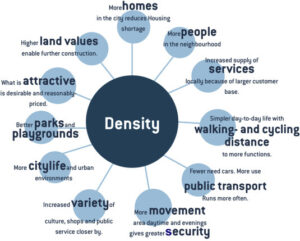
Benefits of the compact city
(Source: Bibri et al., 2020)
How can compact city design be implemented in India’s Tier 2 and 3 cities?
Indian urban planning has traditionally approached the challenges of growing cities cautiously, often opting against densification due to concerns about congestion and the strain on infrastructure. However, the characteristics of compact cities suggest that increased population density can yield significant benefits when accompanied by thoughtful and strategic planning. As India’s population increasingly shifts towards urban areas, it will be vital for Tier 2 and 3 cities to accommodate this demographic change. Embracing the principles of compact city development can provide substantial environmental, social and economic benefits, making it advantageous for the nation to pursue growth and development within this cohesive framework.
Aurangabad, as an example, has a Development Plan that emphasises optimising land resources and includes an objective of increasing population density, which is characteristic of compact city design (Bhagwat & Varuvel, 2020). Another city, Solapur proposed to increase the area under mixed use from 0.65% to 6.67% between 1994 and 2017. Solapur plans to achieve its compact city goals by implementing Transit-Oriented Development (TOD) (Bhagwat & Varuvel, 2020). TOD, a strategy that includes increasing FSI near transit hubs, and encouraging more people to live and work near public transit stations has been effective in encouraging public transit usage. An excellent example would be Mumbai where the growth in the 1980s and 1990s organically happened along the suburban train routes. This has resulted in the city having 70% of trips being made by public transit (Deloitte, 2019).
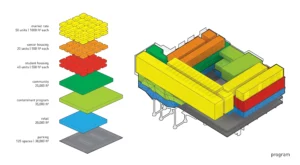
Example plan for how mixed-use land can help integrate different demographics of the population.
(Source: Archinect)
To foster a successful adoption of the compact model in Tier 2 and Tier 3 cities, it will be essential to emphasise inclusivity and environmental sustainability while moving away from auto-centric and suburban lifestyles. These cities can benefit from the experiences of Tier 1 cities, ensuring that they avoid the pitfalls of haphazard planning that have led to significant traffic congestion and compromised air quality. Thought leadership on addressing the underlying issues by prioritising investments in public transit, promoting vertical growth, and enhancing the availability of affordable housing, rather than solely focusing on expanding plot sizes and constructing highways, is the need of the hour.
Anushri Pundit is an intern at Artha Global.