In the last few months, India’s cities have faced extreme heating, flooding, and hazardous air quality. In the national capital New Delhi, air quality has crossed ‘severe’ levels multiple times in the last two weeks. Mumbai, which usually enjoyed better air quality due its vast coastline, surpassed Delhi in early December, with an unhealthy AQI of 308. Recent events of flooding in Gurugram and Bengaluru brought the cities to a standstill. These are signs of a climate crisis, which can be attributed to a combination of rapid global heating, changing local weather patterns, and poor infrastructure and drainage.
Eliminating crop residue burning, a key reason behind New Delhi’s annual poor air spike, can cost Rs 20 billion as per an estimate. Delhi government has committed to spending Rs 50 billion in the next three years to electrify its public transport to control for the other sources of emission. To prevent the next round of floods, Bengaluru will need anywhere around Rs 63 billion, while Mumbai still needs Rs 27 billion or more. In Gurugram, an adequate drainage system was never built and municipal capacity to operate and maintain what exists, is poor, with most infrastructure investments made in a piecemeal manner. The climate challenge is tall, and the size of India’s municipal books does not match. While some might argue that more funding should be devolved to cities, developments across India offer alternative approaches.
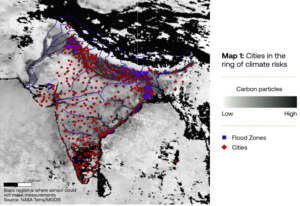
A recent report by Artha Global, on localising green transitions in India, shows major urban clusters are wrapped in a thick layer of emissions and located in flood zones (see Map 1). Indian cities also stand in contrast to a global trend of major cities emitting less per person than the overall national average, as is the case for cities such as London in the UK, Kuala Lumpur in Malaysia and Seoul in South Korea. On flooding too, India’s coastal cities, Kolkata and Mumbai are ranked disproportionately higher on persons exposed to flood risks than others.
While poor urban planning has been cited as a major reason behind urban floods, drainage design and its implementation varies from city to city. The cause of emissions differ for different Indian cities too. Industry contributes a bigger share of emissions in Bengaluru, for example, than in Ahmedabad, where housing is a greater concern.
Where local context is ignored, consequences follow: one out of every five Indian infrastructure projects faces a delay of more than five years because of factors such as inadequate consideration of the environment, slow land acquisition, and poor coordination. Initiatives to help India decarbonise its cities, such as increasing rooftop solar panels, buses and metro systems, are facing similar delays. A greater role for local government, which knows the land and can coordinate better with local stakeholders, could ease these issues. Yet, major projects are largely run from higher levels of government.
Cash is a key barrier stopping municipalities from stepping up. Since octroi was replaced with GST in 2017, municipal annual revenue has dropped significantly. Mumbai, for example, has seen a 35 percent decline in its revenue annually. Local government’s dependency on state and Union funding has increased as a result. Even then, state transfers to municipalities commonly face delays and 60 percent of what does reach municipalities is tied up and conditional. The result is that what funding they can control is spent on maintaining and operating existing assets, leaving little to invest in infrastructure or themselves, furthering their dependency on central bodies.
One argument to improve the situation is for municipalities to receive more money, prescription free, from higher up. This may be the most straightforward solution on paper, and initiatives such as the Aspirational District Programme show government efforts in that direction. But this argument is old and fails in the face of political and economic considerations. Achieving fiscal decentralisation requires both states and the Union government to rebalance their own books, given the money would ultimately come from them. This has not happened to date, despite a push in the 74th amendment – three decades ago – to devolve funding to the municipal level. Expecting, then, a national step change is overly optimistic, particularly given the speed at which climate change needs to be tackled.
New approaches
Developments across India increasingly offer new ways for municipalities to improve their books. Taking a cue from the National Monetisation Pipeline, monetisation of city assets, such as surplus public land and sea ports, offers one route to bolster city coffers. By one estimate, the city of Ahmedabad has surplus public land valued at Rs 457 billion, which could be leased or sold off. For assets such as sea ports, monetisation will provide not only extra revenue, but will cut operational costs for cities. Nagpur has seen the opportunity. It hired PWC to explore how to monetise aspects of its smart city programme, like smart parking and fibre optic lines, worth Rs 5.2 billion.
Opportunities that raise revenue while tackling climate change offer another pathway. Surat has set up the world’s first particulate trading system. During its pilot phase, it has cut emissions from affected industries by 24 percent, boosted industry profits and raised revenue via a permit auction, with the potential for more via fines. As well as establishing their own systems, cities can also engage profitably in international carbon trading. By selling surplus carbon credits for example, Indore raised Rs 5 million. The numbers might be small, but opportunities domestically and internationally will grow. Meanwhile, international examples, such as congestion pricing in London may offer a second pot. The city of London managed to raise an annual revenue of Rs 22.5 billion while reducing traffic congestion using congestion pricing. The size and scope of the charge will likely look different in India, given the challenges Delhi has faced in implementing it, but some version to tackle world’s worst urban congestion could be pursued.
Municipal bond issues are a third development. In the four years preceding 2021, nine municipal corporations managed to raise Rs 30 billion from capital markets. Yet, many smaller municipalities, still behind on reforming accounting standards, lack the capacity to access them. State governments can step in by instituting funds that act as intermediaries. The Tamil Nadu Urban Infrastructure Financial Services Limited is one such fund, enabling municipalities to obtain finance for infrastructure projects from private financial institutions that they would not be able to obtain otherwise. For bigger municipalities, movements by SEBI and RBI to clarify the criteria around green investments will also help attract more funding, including from the wealthy nations that India demands pay their fair share at COP.
Achieving climate ready cities depends on how fast, efficiently and effectively the Indian government at all levels can deliver it. Cities are the weakest link. Boosted spending power as a result of monetisation, diversified revenue, and greater access to capital markets offers a menu of options that will help cities play a greater role.
Sam Downes also contributed to this post.