Disputes have long been a thorn in the side of progress, with underdeveloped countries incurring a higher cost to resolve them as compared to their wealthier counterparts. However, with the advent of the digital age, innovation has paved the way for a different approach: Online Dispute Resolution (ODR).
ODR systems use technology to streamline the dispute resolution process, offering a faster, and more efficient alternative to traditional avenues like negotiation, mediation, and arbitration (Alessa, 2022). The form of ODR can vary depending on the automation it is built on. The simplest forms mimic face-to-face mediation via text, phone, or video, while the most advanced systems use algorithms to propose solutions based on precedents, without any human input. With ODR platforms increasingly integrating with Digital Public Infrastructure (DPI) such as digital identification and payment systems, the future of dispute resolution is set for exponential growth.
While initially developed by private entities like eBay to settle customer disputes and small sum claims, ODR has caught the attention of several governments, leading to increased interest in this technology-driven dispute resolution method.
Figure 1: Global ODR Examples
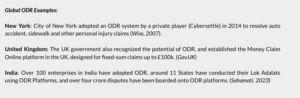
Source: Author’s creation
Online Dispute Resolution: An Analysis
Aspects of Online Dispute Resolution: ODR provides several benefits from being cost effective to removing innate human biases. However, unchecked implementation can undermine their benefits. This blog examines four critical elements—efficiency, access to justice, fairness, and trust —that are key considerations while developing ODRs.
- Efficiency: ODR provides cost-effective dispute resolution, especially for low-value claims, allowing citizens to bypass expensive court proceedings. Additionally, it allows parties to submit arguments intermittently or opt for a ‘documents-only’ process (decisions are based entirely on written and document submissions), overcoming geographic barriers and reducing delays. However, there may be additional expenses for accessing the required software and hardware. From a judiciary lens, uncoordinated ODR processes, a potential result of varying engagement levels and technical difficulties can prolong resolution timelines.
Governments may help by increasing investment in preliminary ODR ecosystem development to reduce financial burden on relevant stakeholders. Additionally, they can conduct outreach programs to promote ODR services and assist those facing technological challenges. - Access to Justice: ODR expands justice’s reach to disadvantaged groups, overcoming socio-economic barriers. Apart from this, they would ease the burden on current legal systems, allowing complex cases to get necessary attention and thereby improving the quality of justice delivered. However, disparities in technological proficiencies across diverse groups can hinder participation in ODR proceedings, worsening existing inequalities. Lack of ODR awareness among the disadvantaged further tilts the scales towards those already legally equipped.
Governments can boost ODR adoption through awareness programs and training. They can also create guidelines to encourage private ODR innovation while making sure its design caters to unique user requirements. - Biases and Fairness: ODR platforms, particularly text and email-based ones, remove audio-visual cues related to gender, social status, ethnicity, and race. They focus solely on resolving disputes based on the claims and information provided by the parties involved and in turn removing inherent human biases. At the same time, debates surrounding the ethical implications of machine-driven decision-making and the suitability of disputes for ODR remain unresolved.
Governments would need to uphold principles of fairness by developing ODR infrastructure (both technical and human) that includes a wide range of perspectives and experiences to help mitigate biases. - Trust and Security: ODR systems provide a uniform platform to upload documents that are accessible to all stakeholders involved in the dispute. Since the ODR process and timeline is carefully documented on this platform, transparency and trust is built into the system. However, without adequate regulation, ODR platforms may risk eroding user trust in respect to confidentiality and ethical standards.
To maintain a level of governance and security, ODR frameworks should be regularly assessed by appointed authorities to ensure compliance with data privacy, data protection and security laws (applicable to the jurisdiction). Additionally, establishing ODR accountability systems can help governments identify areas for improvement and foster public confidence in the integrity of the dispute resolution process as a whole.
Integrating Digital Public Infrastructure (DPI) in ODR
According to a report by OECD, around 4 billion people worldwide or ~50% of the global population, lack legal protection, due to poverty and marginalisation. Nonetheless, 63% of the world’s population has internet access (World Bank, 2021), showing a significant opportunity for ODR to be embraced by many, potentially increasing access to legal rights globally.
Adopting DPI-based ODRs particularly (ODRs using digital public goods, and open source software) increase access to justice by extending legal resources to unreachable, underserved sections of the population. Linking National ID platforms to ODR platforms can allow citizens to file complaints or participate in dispute resolution procedures more efficiently by eliminating the need for separate registration processes and allowing for broader adoption. This can also help with user authentication, ensuring sensitive information is protected and accessed by authorised individuals only.
ODR mechanisms, while offering a pathway to synchronise the justice system with digital advancements, remain in their developmental phase with much of their potential to be fully unlocked.
The Indian Context
Successful technological advancements, including the rise of DPI (with UPI and Aadhar), demonstrate India’s readiness to explore ODR’s true potential.
Over the last few years the Indian Government has acknowledged the potential of ODRs and launched several initiatives to help resolve sector specific disputes (NITI Aayog, 2021):
- 2017: Ministry of Micro, Small, and Medium Enterprises launched the SAMADHAAN portal for e-filing and settling MSE dues.
- 2020: RBI, under a committee led by Nandan Nilekani, introduced ODR for resolving customer disputes related to digital payments.
- Other examples:
- Income Tax Department: E-assessment system.
- Ministry of Road Transport and Highways: E-challan system for easier recording and resolution of disputes.
Figure 2: Rise of ODRs in the Indian Context
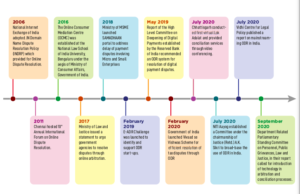
Source: NITI Aayog (2021)
While India has developed several of these sector specific ODR platforms, the Indian judicial system as a whole still remains burdened by a considerable backlog. Data from the India Justice Report 2019 indicates that in 21 states and Union Territories, courts are grappling with cases that have been pending for over five years on average. A 2021 Dalberg report found that Indian court cases cost 30% of claim values. The government is promoting the integration of DPI with ODR to overcome these inefficiencies. NITI Aayog suggests leveraging the India stack to facilitate easy identity verification and data access for dispute resolution. Therefore, increasing DPI adoption in India will inherently broaden ODR’s reach, especially in remote areas.
The future of ODR in India looks promising. Indian ODR policy initiatives, including the NITI Aayog forming a high-level committee chaired by Justice A.K. Sikri to develop an action plan for ODR, aim to foster coordinated efforts from all stakeholders and promote access to justice in India.
References:
- Rabinovich-Einy, O. (2021) The past, present, and future of online dispute resolution. https://academic.oup.com/clp/article-abstract/74/1/125/6369413?redirectedFrom=fulltext
- Alessa, H. (2022, June 16) The role of Artificial Intelligence in Online Dispute Resolution: A brief and critical overview. https://www.tandfonline.com/doi/full/10.1080/13600834.2022.2088060
- GOV.UK (2024). Online Civil Money Claims.
- Niti Aayog. (2021). Designing the Future of Dispute Resolution. https://www.niti.gov.in/sites/default/files/2023-03/Designing-The-Future-of-Dispute-Resolution-The-ODR-Policy-Plan-for-India.pdf
- OECD. (2016). Leveraging the SDGs for Inclusive Growth: Delivering Access to Justice for All. https://www.oecd.org/gov/delivering-access-to-justice-for-all.pdf
- The World Bank. (2020). Individuals using the Internet. https://data.worldbank.org/indicator/IT.NET.USER.ZS
- Sahamati. (2023). Next Gen Dispute Resolution, Removing Friction and Improving Trust in New Ecosystems. https://sahamati.org.in/samvaad-2023-odr-account-aggregator-remove-friction-build-trust/