Growth and Prosperity
The Road to Viksit Bharat @ 2047
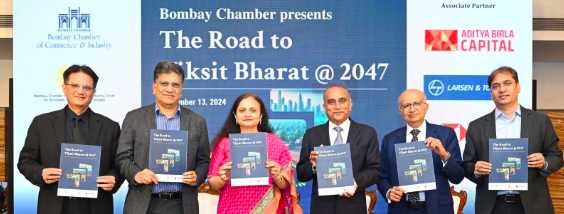
The Road to Viksit Bharat @ 2047, outlines strategic pathways for India’s transformation to a developed economy and society by 2047.
Context
As India advances towards the centenary celebration of its independence in 2047, Prime Minister Narendra Modiʼs visionary roadmap for Viksit Bharat sets the tone for a transformative journey. This ambitious blueprint articulates a national vision that integrates aspirations, goals, and actionable strategies, focusing on economic growth, advancing Sustainable Development Goals (SDGs), improving ease of living and doing business, strengthening infrastructure, and enhancing social welfare. This report, commissioned by the Bombay Chamber of Commerce and Industry, was prepared by a team at Artha Global.
Read the report here.
Methodology
Building on extensive research and stakeholder consultations, this report discusses and analyses six critical nation-building blocks: education and skilling, good jobs, urban reforms, health systems, technology and innovation, and resilience and sustainable growth. It also incorporates comparative studies, drawing lessons from global best practices to inform future national strategies.
The report consisted of an extensive secondary data analysis, a broad literature review of other related papers and research as well as learnings from Key Informant Interviews (KIIs).
Outcomes
The report incorporates comparative analyses, drawing lessons from global best
practices to guide our national efforts. Broadly, policies geared towards improving Indiaʼs human capital, helping firms formalise, and planning for efficient urbanisation will be important on the road to Viksit Bharat.
Key findings and conclusions from the report were as follows:
Macro Context
- India needs a CAGR of 9.6% between 2024 – 2047 to meet the Viksit Bharat target
- Avoiding the middle-income trap will pave the way towards Viksit Bharat
- Shifting geopolitical winds can benefit India as an alternative destination for supply chains, knowledge and consumer markets
- The key to becoming a developed economy by 2047 will thus depend heavily on productivity growth of individuals, firms, and regions.
Education & Skilling
- Only 51% of India’s graduates are employable
- Three areas need particular attention — school infrastructure, teacher training, and curriculum reform
- Need for Indian business organisations to collaborate with governments to design curricula, provide funding support for vocational schools, offer internships to students, map the demand for skills to specific regions of the country, and also provide pathways to integrate informal enterprises into the system of practical training.
Jobs
- India needs to create 8 million non-farm jobs every year over the next decade
- A focus on job creation should mean a focus on job creators — or firms that can hire new workers
- India could boost its growth by 1.5 percentage points per year if just 50 percent of women joined the workforce
- labour-intensive sectors such as electronics assembly, textiles, gems and jewellery, tourism, retail, need to generate formal sector jobs to help raise living standards.
Urban
- Cities contribute an estimated 60% of India’s GDP
- It is crucial to get the urban-rural classification right, to better inform policy design, development planning, governance systems, and finally the flow of funds to each region
- Manufacturing is moving towards smaller cities while the bigger cities are now becoming centres for service sector activity
- India’s urban growth is concentrated, with MMR and NCR alone contributing 16 percent of GDP in 2021. In contrast, China’s 113 cities drive 80 percent of GDP, showcasing balanced growth and higher productivity
- The bodies responsible for administrating cities generate only about 15 percent of their revenue from local sources
- Adopting relevant learnings is necessary for Indian cities to improve their livability and enhance productivity — key measures for India’s journey to becoming Viksit
- Walkable cities with dense mass transit availability can significantly reduce emissions while also improving quality of life
- Prioritising reform of land use and efficiently utilising land will improve supply and lower costs, especially in existing land-starved cities
- This would address the misconception that cities invite people to share an already deficient and immutable infrastructure. Investing in public transit can open up new parcels of land for development.
Health Systems
- India’s healthcare industry has the potential to accelerate tenfold to approximately $37 billion by 2030
- Only 40 percent of households in India had insurance coverage for at least one of its members, with vast geographic variation, emphasising the need for aggressive expansion and coverage
- One out of every nine people in India is expected to be diagnosed with cancer during their lifetime
- Food insecurity in women can lead to reduced labour productivity and participation, particularly in regions where women play a key role in agriculture and informal labour markets
- The Indian health system will benefit from interventions in the following areas –
1) Significantly ramping up awareness programmes, organising screening drives and funding diagnostic testing tools are essential for Indiaʼs changing demographics.
2) Setting up atleast one functional medical college (and hospital) in every district of the country and create regional clusters for specialties to reduce regional inequality of access to care and overcrowding in existing centres.
3) Rapidly increase the number of trained medical professionals.
4) Substantially expand health cover to include testing and medication — and eliminate taxation on premiums. Improving terms of trade and setting up efficient supply chains of medical devices and equipment will go a long way towards improving access to upgraded facilities and technologies.
5) Finally, the use of digital technology such as telemedicine, mobile apps and platforms to port and store medical records, integrate them across health networks, and AI to assist physicians and caregivers will further streamline processes and make them less time consuming and more efficient.
Technology and Innovation
- India’s spending on R&D as a percentage of GDP needs to treble from the current 0.6%
- Given India’s labour-intensive economy, AI should be used to complement and enhance labour productivity, rather than substituting it
- Given Indiaʼs labour-intensive economy, AI should be used to complement and enhance labour productivity, rather than substituting it.
Resilience and sustainable growth
- India aims to reduce a billion tonnes of CO2 emissions by 2030
- A focus on new technologies to cool buildings, cold chains and refrigerants can create investment opportunities of $1.6 trillion by 2040, and potentially 3.7 million green jobs
- Building resilience through environmental measures is particularly important for Indiaʼs long-term development since green infrastructure helps cities cope with climate extremes like floods and heatwaves, while urban forests act as carbon sinks and improve air quality.