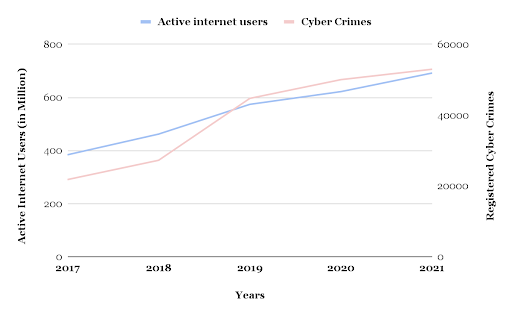
India’s rapid adoption of mobile and other digital technologies and greater levels of internet penetration (IAMAI and Kantar, 2021) have also been accompanied by a concurrent rise in digital violence (Figure 1). This includes tech-facilitated gender-based violence (TF-GBV), which the Report of the UN Special Rapporteur on Violence against Women (2018), defines as “any act of gender-based violence against women that is committed, assisted or aggravated in part or fully by the use of information and communications technology, such as mobile phones and smartphones, the Internet, social media platforms or email, against a woman because she is a woman, or affects women disproportionately”.
Figure 1: Increase in digital penetration coincides with the rise in cybercrime
The growing trend of tech-facilitated gender-based violence in India is evidenced by official records and distressing cases surfacing in the media. According to our analysis of official crime data published by the National Crimes Records Bureau (NCRB), cyber crimes against women account for close to 20% of all cyber crimes (2021) and are among the fastest-growing crimes in India. Between 2017 and 2021, the incidents of gendered cybercrime grew from 4,242 cases to 10,730 cases. In terms of the crime rate per lakh women in India, this translates to an increase from 0.669 (2017) to 1.620 (2021). Fraud and sexual exploitation are the predominant motivators for cyber crimes. Cyber pornography and publishing/hosting obscene material (by individuals or platforms), along with cyber stalking/bullying are the largest individual categories of cyber crimes against women, accounting for close to a quarter of all crimes. However, the bulk (~65%) of gendered cyber crimes are classified in a catch-all bucket ‘others’, limiting further analysis.
The impact of TF-GBV goes beyond the more conventional harms caused to individual survivors as the risk of harms arise from both online content and online behaviours.
Due to a lack of conceptual clarity on what qualifies as TF-GBV, the term fails to capture the range of violence that women and minority genders are subjected to in the digital realm (Hilson et al., 2018). The impact of TF-GBV goes beyond the more conventional harms caused to individual survivors as the risk of harms arise from both online content and online behaviours (Simonovic, 2018). The existing literature does not systematically focus on how response mechanisms can be strengthened to prevent and deter TF-GBV; enough data and evidence are also not available to diagnose the extent of the problem.
Measuring incidence is therefore the critical next step. While most studies in the Indian context use qualitative methods to capture the prevalence of TF-GBV in particular geographies, age groups, etc., the paper presents a quantitative estimation exercise in two states in India to illustrate the need for measurement of TF-GBV for proportionate policy level and grassroots response. This was done through a survey of over 2,000 women, aged 18 and above, in the states of Karnataka and Uttar Pradesh by the Centre for Rapid Insights (CRI), a partnership between Mumbai-based Artha Global, a policy research and consulting organisation and Prashnam.ai, a technology company that has pioneered AI-powered feedback. The survey respondents answered questions through a phone-based Interactive Voice Response (IVR) system, and the paper has a detailed section on methodology and survey administration.
The findings are telling. Close to half the respondents in Karnataka (48%) and Uttar Pradesh (52%) experienced some form of TF-GBV, a higher prevalence rate, as compared to official statistics. In both states, close to a third of the respondents who experienced victimisation indicated that someone created their fake profile. Of the respondents who experienced victimisation and completed the survey, a plurality approached social media and other online companies for redress (37% in Karnataka and 45% in Uttar Pradesh), indicating that intermediaries might be the first choice for survivors seeking redress. 22-24% of respondents who experienced victimisation approached the police and 10-14% approached local NGOs across both states. In Karnataka, close to 29% of respondents who experienced victimisation chose to not seek any external help; the same was the case for close to 16% of respondents who experienced victimisation in Uttar Pradesh.
This paper presents a case study of India’s public (police) and private (intermediary) institutional response mechanisms to tech-facilitated gender-based violence (TF-GBV), in order to understand capacity gaps and recommend opportunities for strengthening these mechanisms. The paper focuses on three foundational aspects—definitions, prevalence and institutional response. It begins with a review of the nature of TF-GBV, looking at the harms and impact of the crimes and the tools and tactics adopted by perpetrators. From this, the authors compile a taxonomy framework to help build an understanding of the spectrum of TF-GBV. The aim is that a conceptual compilation can guide stakeholders in identifying the various types of cyber criminal behaviours, particularly those of a gendered nature.
The crucial focus of the paper is in analysing the institutional response to TF-GBV in India from the police and intermediary perspectives.
The crucial focus of the paper is on analysing the institutional response to TF-GBV in India from the police and intermediary perspectives. With law enforcement, people face barriers when reporting and registering TF-GBV cases and police personnel face technical roadblocks in crime investigations of such cases. Intermediaries, on the other hand, lack the capacity and intent for enforcing grievance redressal mechanisms and content moderation. Finally, the paper proposes recommendations for augmenting institutional response shortfalls through gender-sensitive policing and training, building technical capacity (via training and partnerships) of the police, and fostering multi-stakeholder working groups/task forces for law enforcement. In the case of intermediaries, the authors recommend proactive measures such as establishing ‘reporting centres’ for victim support, conducting independent audits of existing grievance redressal mechanisms, and setting industry-level standards and regulations.
Note: This work was done by the author/s when they were a part of the IDFC Institute and is republished here with permission.